
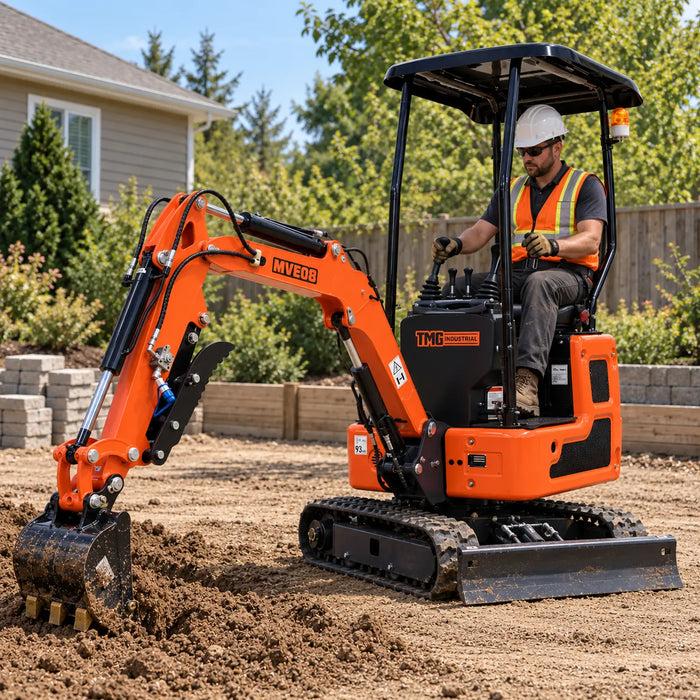
The machine has to get there before it can dig
Specification sheets for small excavators lead with digging depth, and that is the number people compare. In practice the jobs a TMG Industrial’s compact mini excavator actually gets hired for are decided much earlier, by whether it fits down the side of a house, through a gate, and onto a trailer that can legally be towed to the site.
Across Canadian suburbs the constraint is almost always the same: a fence line, a gate, and a narrow strip between the house and the property boundary. Dig depth is irrelevant if the machine is still sitting on the street, and that is where a lot of quoted jobs quietly end.
The gate is the specification nobody prints
Residential gates are commonly built to around three feet of clear opening, and side yards turn out narrower than the fence suggests once a gas meter, a downspout or an air conditioner pad is counted in.
A compact excavator under about forty inches wide can work in those spaces. One a few inches wider cannot, and no amount of operator skill changes that, because the limit is geometric rather than a matter of care. Width deserves to be read before anything else on the sheet.
Height matters less often but catches people out when it does. Overhanging eaves, a low carport roof and mature branches all set a limit that is easy to forget while looking at a machine standing in an open yard.
Weight decides the trailer, and the trailer decides the licence
An operating weight near nineteen hundred pounds puts a compact excavator inside what a standard utility trailer and a half ton truck can handle, which is the difference between calling a float and simply hooking up and driving.
That threshold is not arbitrary. Trailer ratings, tongue weight and licence class all step up at predictable points, and a machine sitting just under the first step is much cheaper to move. Over a season of small jobs, transport often costs more than the machine hire itself.
It also changes who can run the work. A one person operation can move a machine in this class alone, on a weekday, without arranging a float or coordinating with anyone else, and that independence is worth as much as the hourly rate.
What the small size costs
None of this is free, and the honest trade is cycle time. A larger machine moves more per pass, reaches further, and needs repositioning less often, so on an open site it will finish the same excavation considerably faster than this one does.
Reach also limits the work pattern. With sixty one inches of digging depth, anything deeper means either a different machine or a stepped excavation, and the bucket returns to the same spoil pile more often because the machine cannot swing as far.
The point is not that compact is better in general. It is that on a constrained site, a machine that fits through the gate and arrives on a trailer behind a pickup is doing work while a larger one is still being scheduled.
Attachments change the economics more than size does
Because the carrier is cheap to move, excavator attachments decide how many different jobs it can be sent to. An auger turns it into a post hole machine for a fence crew; a breaker covers small demolition; a thumb makes it a brush handler.
Each of those jobs on its own might not justify bringing a machine to site at all. Taken together they justify owning one, and that arithmetic is the reason this size class exists rather than being treated as a compromise.
Before it goes on the trailer
Four checks cover the move itself:
- Measured width against the narrowest gate
- Trailer rating against machine plus bucket
- Tie-down points, four of them, crossed
- Fuel and controls secured for travel
TMG Industrial builds this compact excavator at around nineteen hundred pounds with a twelve horsepower air-cooled engine and sixty one inches of digging depth, which sits at the access-first end of the market. Whatever machine you consider, measure the gate before reading the rest of the sheet.